Bootstrapping · Funding · Founders
Bootstrapping vs venture capital: I have done both, and why we bootstrapped

I have raised money before, with other companies. With Finest Future we decided from day one to take none: no investors, no bank loans, no credit. It grew to €9.3 million a year in four years anyway. Here is what bootstrapping gives you that venture capital doesn't, what it costs you, and how to decide.
Short answer
- Bootstrapping means the company lives on its own sales revenue. Venture capital means selling part of the company to investors who fund faster growth and expect a large return.
- We bootstrapped Finest Future because it was a mission-driven company, and we did not want investors telling us to maximise profit and pay them back as fast as possible.
- It worked because the service had real, unique value, a high price point and a low monthly burn, so the margins could pay for growth.
- Bootstrapping gives you control, creativity and the freedom to change direction cheaply. It costs you speed, comfort and any room for failure.
- Neither path is an excuse. Whichever you choose, set goals ambitious enough that you are a little afraid to say them out loud.
What is the difference between bootstrapping and venture capital?
A bootstrapped company relies on sales revenue alone. You are not going after investors, not asking banks for money, not taking credit or small loans. You rely on what you have: your expertise, your network and your ability to get revenue in.
A venture-backed company sells shares to investors in exchange for money to grow faster than its revenue allows. That money comes with expectations: a board, a timeline, and investors who need their return. Raising it is hard work too. I have done funding rounds with other companies, and gathering funds is a full-time job.
| Question | Bootstrapped | Venture-backed |
|---|---|---|
| Where growth money comes from | Your own sales | Investors, in exchange for shares |
| Who decides | You | You, with a board and investors |
| Speed | As fast as revenue allows | Faster, by spending ahead of revenue |
| Room for failure | Little: every euro counts | More, while the money lasts |
| Cost of changing direction | Low: experiments are small | High: big bets are hard to abandon |
| What happens to profit | Yours to decide, usually reinvested | Expected to turn into a return for investors |
Why did we bootstrap Finest Future?
It was a conscious decision when we started. Finest Future is a mission-driven company, and we did not want anyone who gave us money to come in and tell us to maximise profits and return their investment as quickly as possible. We wanted none of that, so we decided the best way for us was to be bootstrapped.
That left the question every unfunded company starts with: where does the money come from, and how fast? For us the answer was Finnish municipalities that were about to lose their schools. The whole sequence is in how we bootstrapped Finest Future to €9.3 million.
What made bootstrapping possible?
- A product with real value. Nobody had done it before, and it solved a problem customers could not solve alone. You cannot bootstrap something people do not urgently need.
- Two kinds of customers. The public sector in Finland and families in Asia and elsewhere. If one side slowed down, the other made up for it, so revenue risk was spread early.
- Low burn, high price. We kept our monthly burn rate low for a long time. Low costs and a product with a high price point give you good margins, and those margins are what you grow with.
- Everything went back in. Every euro of profit went into the product and into better people, because a company lives or dies by the people who work for it.
What does bootstrapping give you that funding doesn't?
Nobody waiting for their money back
There are no investors waiting for a return and no board members to convince. You decide what to do with what you earn.
Creativity, because you have no choice
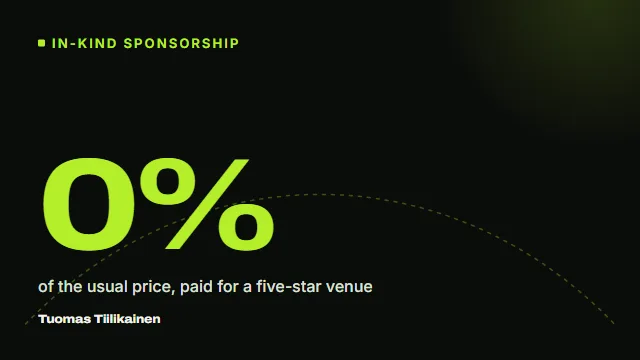
When you have no money for marketing and no millions for expansion, you become critical of every decision, and you start seeing opportunities others miss. Money is cheap; offering it is what everyone does. We got a five-star venue, celebrities and flights for an event for a fraction of the usual price by paying in value instead. That story is in how to get event sponsors with no budget.
The freedom to change direction
A funded company that has just spent a hundred thousand dollars on one marketing angle in a month or two is a little married to it. It needs that angle to work, so switching to something new feels like throwing the money away. A bootstrapped company spends so little that it can try one thing today and another tomorrow. Trial and error is cheap when each trial is small.
A result that is yours
Bootstrapping is hard, and because it is hard it is rewarding. When you get there, nobody was handing you money. You did it yourself.
What does bootstrapping cost you?
Speed, first of all. I thought it would take ten or twenty years to reach where we got in four. It is not the fast lane, it is not sexy, and you will not be part of the crowd backed by the big Silicon Valley funds. You also have very little room to fail: there are no tens of millions in the bank to absorb a mistake, so you have to stay focused on sales every month.
And you cannot buy attention. You cannot throw millions into marketing and branding campaigns, so you have to be extremely focused on getting your own brand known some other way. The way we did it is in the five-step bootstrapping playbook.
Should you bootstrap or raise venture capital?
Ask yourself three things.
- Will customers pay you now? If you can sell a valuable product today, try growing on revenue first. If your plan needs heavy spending long before anyone pays, revenue alone may be too slow.
- Can your margins fund the next step? Low burn and a high price point are what made it work for us.
- Whose timeline do you want to live on? Investors need a return. If that would pull the company away from its mission, the money is expensive.
And whichever you choose, aim high. The problem I see most with bootstrapped companies is that the bar is too low. Being bootstrapped is not an excuse to think small, and neither is being funded. If you want to build a global company, you have to do things other people are either not capable of or not willing to do.
Questions
Can a bootstrapped company grow fast?
Yes. Finest Future went from zero to €9.3 million in yearly revenue in four years with no investors and no loans. It needed a product with real value, a low burn rate and every euro of profit reinvested.
Did Finest Future ever take outside money?
No. No investors, no bank loans and no credit. Growth was paid for by revenue: first from Finnish municipalities, then from families through a partner network in more than 15 countries.
Is bootstrapping better than venture capital?
Neither is better in general. Bootstrapping keeps control and forces creativity; venture capital buys speed. For a mission-driven company whose customers pay from the start, bootstrapping was the better fit for us.
Is the bootstrapping mindset useful for funded companies?
Very. Even a company with plenty of funding wants the best return on what it spends, and nothing returns more than revenue that did not need a marketing budget to win.
More on Bootstrapping
Published .
Want this applied to your company?
A keynote for your event, coaching for the next stage, or consulting for a market entry. Tell me what you are trying to move.