Bootstrapping · Finest Future · Emerging markets
How we bootstrapped an education company from zero to €9.3M in four years

Finest Future went from zero to €9.3 million in yearly revenue in four years with no investors, no bank loans and no outside money of any kind. This is how it happened, decision by decision, including the side business that never took off.
Short answer
- Bootstrapping means the company lives on its own sales revenue: no investors, no loans, no credit. For Finest Future it was a deliberate choice, to keep a mission-driven company free of anyone demanding a quick return.
- The first customers were Finnish municipalities whose schools were losing students: two deals in the first two months, seven in about six months.
- Those one-off payments funded the move to Vietnam and a partner sales network that brought students every month, with no marketing spend.
- Revenue went back into quality: digital learning products, teaching systems, more people and a dedicated customer success team. Later our own sales team beat our biggest partner within five months.
- It worked because the service was the first of its kind, solved a real problem, and had two kinds of customers on two continents, which spread the risk.
Why did we choose to bootstrap?
Bootstrapping means relying on sales revenue alone. You are not pitching investors, not asking banks for money, not taking credit or small loans. For us it was a conscious decision from day one. Finest Future is a mission-driven company, and we did not want anyone who gave us money to walk in and tell us to maximise profit and return the investment as fast as possible.
That left one question, the same one every unfunded company has: where does the money come from, and how fast? How that choice compares with raising money is in bootstrapping vs venture capital.
Where did the first revenue come from?
We had several projects we could have pursued. We looked at them the way you look at a sales funnel: who is most likely to buy, how big is their problem, and how much is our solution worth to them?
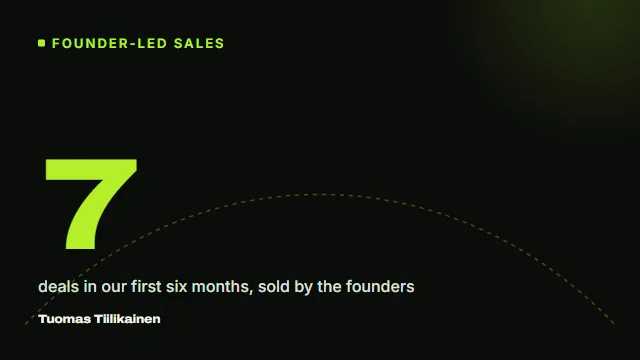
Our first customers were Finnish municipalities, and their pain was concrete. Without students, their upper secondary schools close, and without schools, families leave. We offered to bring international students into their schools and priced it as a marketing and success fee. When the alternative is losing your school, that is a powerful proposal. We closed the first two deals within two months of starting and seven in about six months.
How did one-off money become monthly revenue?
Those deals were one-time payments, not recurring revenue. We had a lump of money in the bank and one job: turn it into revenue that arrives every month. Our customers, the students and families, were not in Finland, so we set up operations in Vietnam, hired an intern to get started, and sent me to run revenue operations there. I have been in sales since I was 21.
The roles were clear. Bambi Dang, our co-founder, became CEO in Finland and ran the product and service. Peter Vesterbacka, co-founder of Slush and the "Mighty Eagle" of Angry Birds, took Finest Future to the public and the media and opened doors.
How did we sell with no marketing budget?
Through 2021 the challenge was predictable sales. A lump of money pays salaries for a while; it does not make a company. We solved it by building a network of sales partners who were paid from the revenue they brought in, not from money we did not have. Students started arriving at regular intervals: a couple a month at first, then tens a month. That network later took us into more than 15 countries. The method is in the partnership playbook.
Where did the money go?
Into quality, as in any business that wants to last. We spent revenue on digital products and teaching systems, recruited more people, and built a dedicated customer success department. That department proved to be one of the most important decisions we made, and it shaped the company for a long time.
What did not work?
We also tried a second, completely different line of business: helping startups come to Finland. It took us into B2B. It brought in some money but never grew big. A bootstrapped company can afford experiments like that only while the core keeps paying for them.
When did we start selling ourselves?
Partners taught us what sells, to whom and at what price. With that knowledge we set up our own sales office in Vietnam and built a sales and marketing team in-house. It took a month or two to win our first direct customers. Within five months our own team was out-selling our biggest partner. Nobody can sell your product better than the people who built it. The whole switch is in when to build your own sales team.
Why did it work?
- Real, unique value. Nobody had done this before. It solved a visible problem for customers who could not solve it alone.
- Two kinds of customers. The public sector in Finland on one side, private families in Asia and elsewhere on the other. If one side slowed down, the other could make up for it, so the revenue risk was spread from early on.
- Every euro went back in. In under five years the Vietnam company grew from its first 15 students to more than 1,000 across Vietnam, Thailand, Indonesia and Myanmar, and was recognised at the Asia Pacific Enterprise Awards two years running.
Going from zero to €9.3 million in four years was something I could not have dreamt of. I thought it would take ten or twenty years.
I am not a multi-millionaire. I am living exactly the life I dreamt of, and the company paid for every step of it. What ended the Finnish chapter was not the market. It was a change in Finnish law. The five steps that sum up this playbook are in how to bootstrap a business.
Questions
How did you price the first deals with no track record?
Against the size of the customer's problem, not against our costs. A municipality about to lose its school puts a high value on keeping it open, so a marketing and success fee was easy to justify.
Would you bootstrap again?
Yes, for a mission-driven company. Bootstrapping kept the mission ours. It is slower and harder than raising money, and it forces a discipline that funded companies rarely learn.
More on Bootstrapping · Finland and education
First published . Last updated .
Want this applied to your company?
A keynote for your event, coaching for the next stage, or consulting for a market entry. Tell me what you are trying to move.