Bootstrapping · Marketing · Founders
How to bootstrap a business: five steps to $10M with zero ad spend

We have all been told that you have to pay to play: Facebook ads, YouTube ads, Instagram ads, money into the machine and hope for a return. I took a company from zero to more than $10 million in yearly revenue in four years without spending a dollar on online advertising. These are the five steps to bootstrap a business without an ad budget, and the mindset they need first.
Short answer
- Bootstrapping a business means growing it on its own sales revenue, with no investors or loans. Growing without ads means paying for that growth with your own expertise, network and selling time instead of an advertising budget.
- Step 1: validate with real customers, not friends and family. Step 2: launch a minimum viable product and sell what can be sold today.
- Step 3: sell it yourself until you have your first 50 deals. Step 4: market without money through content, community, partnerships and word of mouth, with a founder's face on it.
- Step 5: reinvest what you earn into the product, or a competitor will copy you and do it better.
- It is slower and harder than raising money and buying ads. What you get for it is a product people love, a stronger brand and growth that does not stop when the budget does.
 14:40
14:40In the video
- Grow a business without spending on ads
- The bootstrapping mindset
- Why paid ads are a Broadway show
- Step 1: Validate with real customers
- Step 2: Launch the MVP, not the perfect product
- Step 3: Sell it yourself
- Step 4: Marketing without money
- Build a community around your customers
- Partnerships: let others sell for you
- Word of mouth: be the face of your company
- Step 5: Reinvest everything you make
- The playbook behind $0 to $10M
- The honest truth: bootstrapping is hard
- Recap: all 5 steps
- Why it's worth it
Why are paid ads a Broadway show?
Bootstrapping means growing a company without outside money, or at least being very careful with the money you have. You are not chasing funding. You rely on your own expertise, your network and your ability to get revenue in.
Paid advertising is like building a billboard or a Broadway show. It is impressive while the money lasts. The day you can no longer pay for it, sales drop, the marketing team gets cut and the company goes down with it. Even if you have raised money, these steps still matter: what you want is a great return on marketing spend, and nothing beats revenue you earned with almost no marketing spend at all.
Step 1: Validate with real customers
Do not guess. Be certain your product stands out: different from the competition, extremely valuable to whoever buys it, and with a story that sets it apart. Get there by practising your pitch and understanding your ideal customer until your stories resonate with them.
Posting on X or Instagram and asking friends and family to try it is the wrong path. Those people will never really engage. You need real customers in your field using the real product and giving you honest feedback. At this stage you are not after big money. You are after testimonials, experiences and people who will vouch for you, and who later become fans who sell for you without being asked.
Step 2: Launch the MVP, not the perfect product
This is the step that destroys the most good ideas. There is no perfect product, only iterations. Get a minimum viable product out as fast as you can. Do not spend months polishing features or crafting the most beautiful deck. Sell what is useful and what can be sold today. If you cannot sell the MVP, you will not sell the finished version either.
Step 3: Sell it yourself
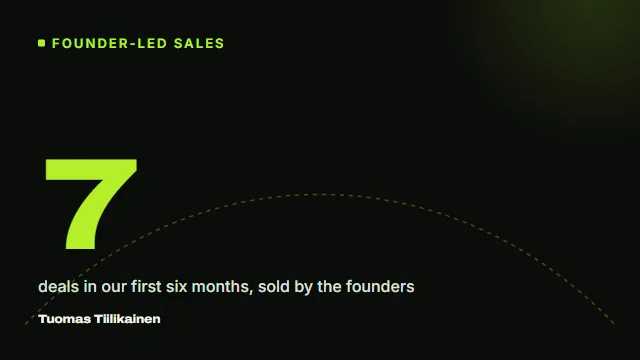
Not automated and not outsourced. If you are the CEO or one of the senior people, you are the company's salesperson. Nobody knows the product better than you, and if you cannot sell it, nobody can. Get out of your chair and out of your head: meetings, online calls, cold calls, cold emails, whatever it takes to close your first 50 deals. With 50 deals you have a track record and testimonials, and step four becomes possible. More on doing this well is in founder-led sales.
Step 4: Marketing without money
- Content, SEO and AEO. With no ad budget, your content and your search presence have to be spot on, and in the age of AI so does your answer-engine optimisation. The best organic stories are customer transformations: the pain they had and how your product took them to the next level. Be creative and, above all, consistent: post multiple times a week if not daily.
- Community. Your customers already gather somewhere: an association, a union, an industry body, a forum. Go where they are and deliver value there. Do not skip this; it pays off later, and it pays off big.
- Partnerships. One of the fastest ways to revenue is to piggyback on what others already have. A sales partner takes a higher commission because you are not paying them a salary, and your product reaches their customers right away. The full method is in the partnership playbook.
- Word of mouth, with a face on it. As you deliver goodwill into the community, people start to talk. Every company needs a face. If you are the founder, be out there: your credibility is attached to the product, so hold on to your integrity and word of mouth starts working for you.
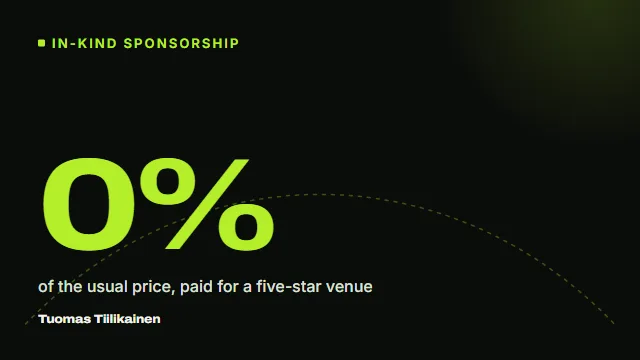
One worked example of all four, an event with a five-star venue, celebrities and flights for almost nothing, is in how to get event sponsors with no budget.
Step 5: Reinvest everything you make
You will not reach the perfect product any time soon. But if you stop investing in it, a competitor who sees your traction will copy you and do it better. Put what you earn back into the product, the service and the people you need. Do not take the money and call it a day. You are here to build a multi-million business, not to become a multi-millionaire overnight.
The honest part: is it worth it?
Growing without ad spend is not easy. It is the opposite of easy, and it is slow. If you want a quick way to get rich, this is not it; go to the VCs and hope you spend the millions wisely. You will not be one of the companies backed by a big Silicon Valley fund, and it is not sexy.
What bootstrapping gives you is creativity, a product that is truly the company's priority, a stronger brand, a stronger personal brand and a community that trusts you. Every feature you launch later lands better because you showed up day after day. And when the results come, you did it yourself.
All you need is a real problem you are solving, and a playbook you stick to one hundred per cent.
How the same steps played out at Finest Future, from the first municipal deal to €9.3 million a year, is in the bootstrapping story.
Questions
What does bootstrapping a business mean?
Running and growing a company on its own sales revenue: no investors, no bank loans, no credit. You rely on your expertise, your network and your ability to sell, and you reinvest what you earn.
Should you bootstrap or raise money?
Bootstrap if customers will pay you now and your margins can fund the next step; raising buys speed at the cost of control. The trade-offs are in bootstrapping vs venture capital.
Does this apply if we already raised funding?
Yes. Funded or not, you want the best return on your marketing spend. Running these steps first means any ad budget you add later goes into a product that already sells, with a message customers already repeat.
How long until organic channels bring revenue?
Partnerships can bring revenue within weeks. Content, community and word of mouth take months to compound. Sell manually in the meantime; that is what step three is for.
Should you never spend on ads?
Not never. There may be a time later when ads make sense. In the early stages, and in today's economy, do not be the company that spends its money on advertising before the product sells on its own.
More on Bootstrapping
First published . Last updated .
Want this applied to your company?
A keynote for your event, coaching for the next stage, or consulting for a market entry. Tell me what you are trying to move.