Finest Future · Regulation · Leadership
We built a $10M business. Our own government killed it.

For five years Finest Future brought students from Asia into Finnish schools that were running out of young people, and for five years parts of the Finnish state treated us as a problem to remove. In December 2025 Parliament passed a law that put tuition fees on new students from outside the EU and EEA, and our Finnish company did not survive it. This is what happened, with the documents.
Short answer
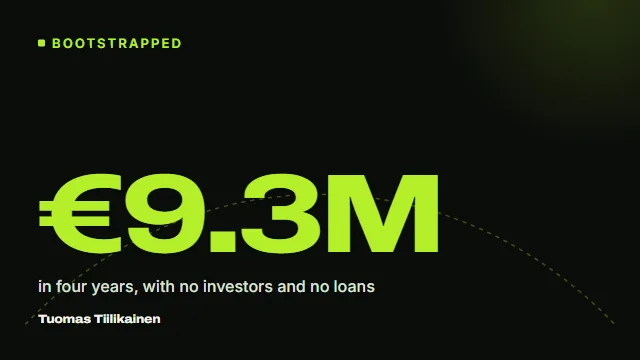
- Finest Future, which I co-founded in 2020 with Peter Vesterbacka and Bambi Dang, was bootstrapped to €9.3 million (about $10 million) in yearly revenue by bringing students from Asia into Finnish upper secondary and vocational schools.
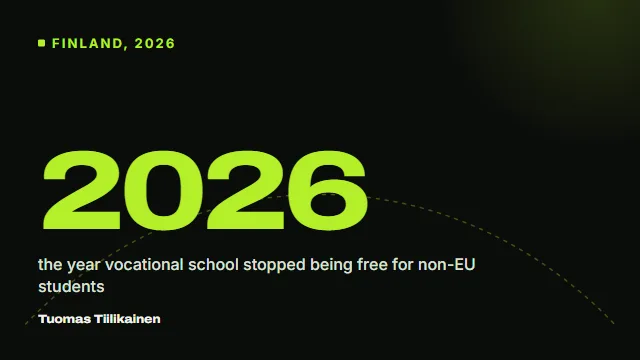
- Government bill HE 143/2025 introduced tuition fees for new non-EU/EEA students in upper secondary and vocational education. Parliament passed it 131 to 42 on 10 December 2025, and it came into force on 1 August 2026.
- When Parliament's Education Committee took evidence on the bill, it heard more than 20 experts in person and received 14 written statements, one of them from a competitor of ours. Finest Future was not asked.
- The Finnish company went bankrupt. Finest Future continues outside Finland, from our office in Vietnam.
- My three lessons: never underestimate ideology, outlast the bigger players because you will not out-shout them, and prepare for the risk you think is absurd.
 21:09
21:09In the video
- The day my country turned against me
- The hidden reality behind the happiest country
- Challenging the sacred industries
- When ideology triumphs over facts
- The law designed to stop our progress
- Losing the battle but winning the mission
What were we trying to fix?
Finland is famous for quality of life, great education and equality. It has been named the happiest country in the world nine years in a row. Underneath sits a hard problem: a shrinking population, too few young people and a talent shortage in nearly every sector.
Some industries in Finland are treated as sacred, best left to the state. Railways are a state monopoly. Strong alcohol is sold only by a state-owned retailer. And education has long been seen as a basic right that nobody should pay for.
We set out to work in one of those sacred fields anyway. Education is the best way into a new society: students learn the language, finish school in Finland, and many go on to work there. Municipalities and schools appreciated what we did, because it kept their schools open and their teachers employed.
How did the fight start?
About six months in, the first critical article ran (Yle, 21 January 2021). Its angle was taxpayer money: upper secondary education in Finland is free and paid for by the state, so why should Finland pay to educate foreigners who will supposedly leave? A later headline called us a "million-euro business" (Talouselämä, 26 November 2023), and the articles that followed kept to taxpayer money and ethics.
The questions moved into Parliament. On 29 January 2021 an MP filed written question KK 1045/2020 on "the business of bringing upper-secondary students to municipalities from abroad". On 18 November 2022 she filed a follow-up, KK 591/2022, which names Finest Future in its first sentence. She is now Minister of the Interior, the ministry responsible for immigration.
In November 2023 it was reported that a government memo to Finland's embassies around the world called our model questionable and said it should not be supported (Helsingin Sanomat, via Kuntalehti, 24 November 2023). We were following the law. But if you do business in Asia, you know how much a government's backing matters, and that memo followed us into every room.
Why didn't the numbers win?
The hardest lesson for me: when enough people share a strong belief system, facts and economics stop mattering. We argued with numbers. The other side did not need to.
Meanwhile the company grew. From 2021 we bootstrapped the whole thing, with no outside investment, no loans and no debt, to €9.3 million in yearly revenue. We were close to being a scale-up rather than a startup, and too big to be pressured into closing. Whoever wanted us gone needed something that would end it in one go.
What did the law actually do?
The government submitted bill HE 143/2025 on 9 October 2025. The change was not in the government's 2023 programme; it came out of the 2025 mid-term budget review, at a time when the economy gave every cut an easy argument.
- Tuition fees. New students from outside the EU and EEA pay tuition fees in general upper secondary and vocational education, even if they study in Finnish. Students already in Finland can finish free of charge (Yle, 10 October 2025). What schools now charge, and who is exempt, is in Finland's vocational school tuition fees.
- Less funding for the schools. The state stops paying for those study places: about €12 million less for education providers in 2026 (€10 million in vocational education, €2 million in upper secondary schools), rising to €18 million a year from 2027 (Association of Finnish Municipalities, statement of 26 June 2025). For upper secondary schools, Yle put the state's saving at around €2 million. Small rural schools that depend on international students carry the cost.
- Harder visas, in parallel. Study permits needed more money in the bank, decisions got slower and application fees went up.
| Date | What happened | Source |
|---|---|---|
| 21 Jan 2021 | First critical article on Finest Future and taxpayer funding | Yle |
| 29 Jan 2021 | Written question on bringing upper secondary students from abroad | KK 1045/2020 |
| 18 Nov 2022 | Follow-up question names Finest Future | KK 591/2022 |
| 24 Nov 2023 | Memo to embassies reported | HS via Kuntalehti |
| 26 Nov 2023 | "Million-euro business" headline | Talouselämä |
| 26 Jun 2025 | Municipalities' association on the funding cut | Kuntaliitto |
| 9 Oct 2025 | Government submits bill HE 143/2025 | Parliament |
| 4–18 Nov 2025 | Education Committee hears more than 20 experts and receives 14 written statements; Finest Future is not among them | Parliament |
| 10 Dec 2025 | Passed, 131 to 42 | Parliament |
| 22 Dec 2025 | Laws confirmed (statutes 1362–1364/2025) | Parliament |
| 1 Aug 2026 | Law in force | Yle |
Who was in the room?
When Parliament's Education Committee took evidence on the bill in November 2025, it heard more than 20 experts in person and received written statements from 14 organisations, including a competitor in the same business and small municipalities whose schools depend on international students. Finest Future, the largest company in the field, was not heard and was not asked for a statement. It is all on the bill's page at eduskunta.fi.
I am not claiming the law was written only to stop us. It changes the whole sector. But we were public and visible, which made us a useful example in the argument, and stopping us was clearly one of the outcomes.
What happened to the company?
Finland stopped being the place our students wanted to go. Fees where there had been none, slower and more expensive visas, and a public tone that had turned hostile: new students did not enrol, and the Finnish company could no longer meet its obligations. It went bankrupt.
I am not going to pretend that did not happen. It did, it sucked, and it still hurts. But they took the Finnish entity, not the mission. Finest Future continues outside Finland; I recorded the video from our office in Vietnam. What entrepreneurs do when one door closes is pivot, and that is what we are doing.
Why did it happen?
- We were a private company making a profit. That is fine in most places.
- In a sacred field. A private company profiting from education was the real offence.
- Decisions driven by anti-immigration ideology. One that puts everyone from abroad, a refugee or a brain surgeon, in the same basket.
What did I learn?
- Never underestimate ideology. Facts, logic and economics do not beat a belief system that enough people share. I learned that the hard way.
- The big players own the narrative. A small company cannot out-PR a government or the national press. You do not win against bigger players; you outlast them. We did for more than five years, and we still are.
- Prepare for the risk you think is absurd. If someone had told me in 2020 that Finland would change its law and end our business there, I would have laughed. I did not even believe the first rumours. Structure the company for the risk you cannot imagine, because the reason you cannot imagine it is lesson one.
You don't win against the bigger players. You outlast them.
This is the story behind my talk on holding your nerve under regulatory pressure. If your leadership team is heading into a regulated or politically sensitive market, it is the one I would tell them first.
Sources
- Government bill HE 143/2025, the committee hearing list and the vote: eduskunta.fi
- Written questions KK 1045/2020 and KK 591/2022
- Association of Finnish Municipalities, statement 327/03.01.00/2025, 26 June 2025
- Yle, Finland moves to introduce tuition fees for non-EU upper secondary students, 10 October 2025
- Yle, 21 January 2021; Talouselämä, 26 November 2023; Helsingin Sanomat via Kuntalehti, 24 November 2023
Questions
Did Finest Future break any law?
No. Every student was enrolled under the rules in force at the time. The government changed the rules; it never found a breach of them.
Who pays the new tuition fees in Finland?
New students from outside the EU and EEA who start general upper secondary or vocational education from 1 August 2026. Permanent residents of the EEA, exchange students and people with temporary protection are exempt, and students already studying in Finland can finish free of charge (Yle, 10 October 2025).
Is Finest Future still operating?
Yes, outside Finland. The Finnish company went bankrupt after the law changed; Finest Future continues from Vietnam, where the Vietnam company won the APEA Fast Enterprise Award in 2025.
More on Finland and education
First published . Last updated .
Want this applied to your company?
A keynote for your event, coaching for the next stage, or consulting for a market entry. Tell me what you are trying to move.