Finland · Education · Regulation
Is vocational school free in Finland? Tuition fees for non-EU students from 2026

Not any more, for most students from outside the EU and EEA. From 1 August 2026, Finland's vocational schools and general upper secondary schools must charge tuition to new students from outside the EU and EEA who come to Finland to study. Here is who pays, who is exempt, what three large schools charge, and how payment works.
Short answer
- Since 1 August 2026, new non-EU/EEA students in Finnish vocational and general upper secondary education pay a tuition fee if their residence permit is based on studies. Swiss citizens are treated like EU citizens.
- Students who started before August 2026 can finish their studies free of charge.
- Exempt: students still in compulsory education, permanent residents, people with international or temporary protection, and exchange students. Some schools list more cases.
- Each school sets its own fee. As published in 2026: Omnia €6,400–12,000 a year, Sedu €9,000–24,000, OSAO €7,500–29,200.
- The schools collect the fee themselves, and fee-paying students no longer count towards the state funding schools receive.
What changed in 2026?
Until 2026, a young person from Vietnam, India or Nigeria could study in a Finnish vocational school or upper secondary school on the same terms as a Finn: free tuition, and in most schools a free lunch. The state paid the municipalities and education providers for every student they took in.
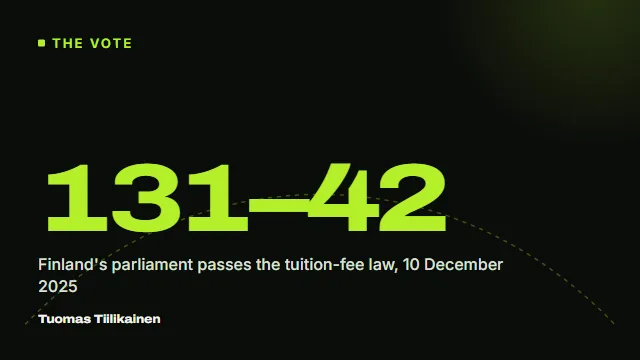
The government submitted bill HE 143/2025 on 9 October 2025. Parliament passed it 131 to 42 on 10 December 2025, and it came into force on 1 August 2026. Students from outside the EU and EEA who start after that date pay tuition, and the state stops paying municipalities for them. Yle reported that ending the subsidies would save the government about two million euros.
The change hits small schools hardest. Yle's example was Savukoski Upper Secondary School in Lapland, where 14 of 22 students had come from abroad. I spent five years on the other side of this debate; that story, with the documents, is here.
Who has to pay?
Citizens of countries outside the EU, the EEA (Iceland, Liechtenstein, Norway) and Switzerland, who start a vocational qualification or general upper secondary studies on or after 1 August 2026, and whose right to be in Finland is based on studies. In the schools' own words, that typically means:
- a temporary (B) residence permit granted for studies;
- a continuous (A) residence permit, if your first Finnish permit was granted for studies;
- a residence permit based on a family member, if that family member's permit is based on studies.
Where you live in Finland does not change the amount. Schools word the permit rules slightly differently, so read your own school's page.
Who is exempt?
- Students who are still in compulsory education in Finland.
- Holders of a permanent residence permit (P or P-EU).
- People granted international protection or temporary protection.
- Exchange students.
- At Sedu: students who start an apprenticeship with a residence permit for an employed person.
- At Omnia: Ukrainian citizens until 4 March 2027.
- Students who started before 1 August 2026, until they graduate.
The fee cannot simply be waived. Omnia, for one, states that it cannot grant exemptions beyond these and checks permit details with the Finnish Immigration Service.
How much does vocational school in Finland cost now?
Each education provider sets its own fee, usually by qualification. These are the figures three of the largest providers published in English in 2026.
| School | Fee per academic year | What the fee includes |
|---|---|---|
| Omnia, Espoo | €6,400–12,000. Business €8,100, cleaning and property services €8,100, social and health care €10,300, restaurant and catering €12,000, further vocational qualifications €6,400 | Teaching, student welfare and learning support. Not free meals or study materials |
| Sedu, Seinäjoki | €11,000 for vocational upper secondary qualifications, €9,000 for further and specialist qualifications, some qualifications €9,500–24,000 | Teaching, study materials, guidance, welfare services, special support and free lunch on teaching days |
| OSAO, Oulu | €7,500–29,200, depending on the qualification. The fee set when you start stays the same for the whole course | Teaching, welfare services and support. Not free learning materials or daily meals |
Checked against each school's page on 10 October 2026. Fees can change for new students each year, so confirm the amount for your exact qualification before you apply.
How and when do you pay?
- Before you start. At Omnia the full first-year fee is due before studies begin, and it is refunded only if your residence permit is not granted. OSAO charges the fee once you have been offered a place.
- Later years. Omnia bills later years per study period, one fifth of the annual fee at a time, before each period starts.
- If you stop. Omnia does not refund fees for studies that are discontinued. Ask your school about its own rules.
- Extras. Sedu and OSAO note that a health examination related to entering Finland may be added in the first year.
Is general upper secondary school (lukio) also paid?
Yes. The same law covers general upper secondary education as well as vocational education and training. Check the general upper secondary fee separately: some schools publish it on a different page from their vocational fees.
What should families do now?
- Find the fee for the exact qualification, on the school's own page, not an agent's brochure.
- Check which permit the student will hold, because the permit basis decides whether the fee applies. The Finnish Immigration Service (Migri) decides on permits.
- Budget for the whole course, plus housing, meals and materials where the fee does not include them.
- Ask what happens if plans change: refunds, breaks in studies, and moving to an apprenticeship.
Sources
- Government bill HE 143/2025 and the vote: eduskunta.fi
- Yle News, 10 October 2025: Finland moves to introduce tuition fees for non-EU upper secondary students
- Omnia: Tuition fees
- Sedu: Tuition fees for vocational education and training from 1 August 2026
- OSAO: Tuition fees confirmed for non-EU/EEA students and Tuition fees for non-EU students starting from 1 August 2026
Questions
Is vocational school free in Finland for international students?
Free for students from the EU, the EEA and Switzerland. Students from other countries who start on or after 1 August 2026 with a study-based residence permit pay a tuition fee set by the school, unless an exemption applies.
Do students who started before August 2026 have to pay?
No. Students who began their studies before the law came into force can complete them free of charge.
What is the cheapest vocational school in Finland for non-EU students?
Fees depend on the qualification more than the school. Of the three schools above, the lowest published fee was €6,400 a year, for further vocational qualifications at Omnia. At Omnia and Sedu, most vocational upper secondary qualifications cost €8,100–12,000 a year.
Do Finnish universities charge tuition too?
Yes, and for longer: universities and universities of applied sciences have charged non-EU/EEA students in English-taught bachelor's and master's programmes since 2017. The 2026 change extended fees to the upper secondary level.
More on Finland and education
Published .
Want this applied to your company?
A keynote for your event, coaching for the next stage, or consulting for a market entry. Tell me what you are trying to move.